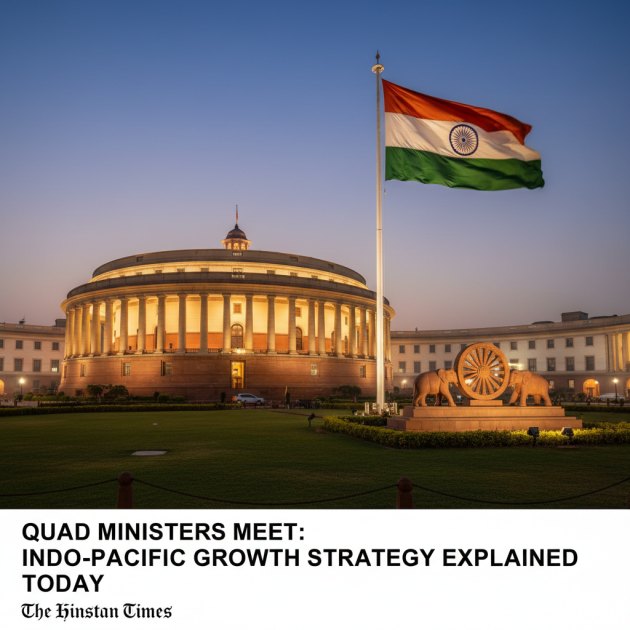
Quad Meeting India: Indo-Pacific Strategy for Global Economic Surge
Quad Foreign Ministers Meet: Charting a Course for Indo-Pacific Growth
Did you know that the Indo-Pacific region, often in the headlines for geopolitical shifts, is projected to contribute over half of the world's economic output by 2030? This isn't just a distant statistic; it has tangible implications for your daily life, your investments, and India's future prosperity. The recent Quad Foreign Ministers' meeting, attended by India’s External Affairs Minister S. Jaishankar, underscored this critical point: the Indo-Pacific must remain the primary engine for global growth. But what does this mean for you, the average Indian citizen? How does this complex geopolitical alignment translate into real opportunities and challenges for our nation? Let’s dive deep into the outcomes of the Quad meeting India had, and understand the nuances of the Indo-Pacific strategy that’s shaping our world.
The Quad, formally known as the Quadrilateral Security Dialogue, comprises India, the United States, Japan, and Australia. While often discussed through a security lens, this latest meeting placed a significant emphasis on economic cooperation and development within the Indo-Pacific. EAM Jaishankar’s assertive stance highlighted India's vision for a free, open, and inclusive Indo-Pacific, one that is also prosperous and resilient. This isn't just diplomatic jargon; it's a strategic blueprint for ensuring that the dynamism of this region translates into concrete benefits for all its stakeholders, especially India.
Why should you care about the Indo-Pacific strategy? Because it directly impacts trade routes, supply chains, technological advancements, and ultimately, job creation and economic stability in India. As the world navigates complex global challenges, from climate change to pandemics and economic slowdowns, a robust and collaborative Indo-Pacific is not just desirable, it's essential. This article will break down the key takeaways from the Quad meeting, explain the core tenets of the Indo-Pacific strategy, and explore what it means for India’s economic trajectory.
Takeaway: The Indo-Pacific region is pivotal for global economic growth, and the recent Quad meeting focused on leveraging this potential. Understanding this strategy is key to grasping India's role and future economic prospects.
The Indo-Pacific Strategy: More Than Just Geopolitics
When you hear "Indo-Pacific strategy," it's easy to think of naval patrols and strategic alliances. However, the recent discussions by the Quad ministers painted a much broader picture. The core idea is to foster an environment where all nations can conduct their affairs freely, transparently, and without coercion. This translates into several key pillars, especially concerning economic development and connectivity:
1. Resilient Supply Chains
The COVID-19 pandemic exposed the vulnerabilities of global supply chains. Many countries, including India, realized the risks of over-reliance on single sources for critical goods. The Quad ministers discussed initiatives to diversify supply chains, making them more robust and less susceptible to disruptions. For India, this means opportunities to become a manufacturing hub for a wider range of products, from semiconductors to pharmaceuticals.
Consider the critical shortage of medical supplies during the pandemic. A diversified Indo-Pacific supply chain would ensure that essential medicines and equipment can be produced and distributed more reliably, not just for India but for the entire region. This also extends to critical minerals and advanced manufacturing components, areas where India is actively seeking to boost its domestic capabilities.
2. Infrastructure Development
A crucial aspect of the Indo-Pacific strategy is investing in high-quality, sustainable, and transparent infrastructure. This isn't about debt traps; it's about building essential connectivity – ports, roads, digital networks – that facilitates trade and economic activity. India, through its own initiatives like the 'Gati Shakti' master plan, is actively contributing to and benefiting from this focus.
Imagine a small Indian entrepreneur in the Northeast who wants to export handicrafts. Improved road networks connecting to ports in the East, facilitated by regional infrastructure development, could drastically reduce transit times and costs, opening up new international markets for their products. The Quad partners are looking at collaborative projects that align with these regional needs.
3. Digital Connectivity and Technology Cooperation
In today's world, digital infrastructure is as vital as physical infrastructure. The strategy emphasizes promoting trusted digital networks, cybersecurity, and cooperation in emerging technologies like AI, 5G, and quantum computing. For India, this means enhanced opportunities for our IT sector and a push towards digital innovation.
Think about the potential for telemedicine in remote Indian villages. With enhanced digital connectivity and cooperation in developing affordable, secure communication technologies, healthcare access can be significantly improved, bridging the urban-rural divide. This also extends to areas like e-governance and digital education.
4. Climate Action and Clean Energy
The Indo-Pacific is particularly vulnerable to climate change. The Quad is committed to working together on clean energy transitions, sustainable practices, and climate resilience. This opens up avenues for India to adopt and develop green technologies, attract investment in renewable energy, and enhance its energy security.
India's ambitious renewable energy targets, for instance, can be accelerated through collaboration on solar technology, wind energy solutions, and battery storage. This not only helps combat climate change but also creates green jobs and reduces our dependence on fossil fuel imports. Your electricity bill could potentially see positive impacts from these advancements over time.
Takeaway: The Indo-Pacific strategy is a multi-faceted approach focused on building economic resilience, connectivity, and technological advancement, with significant implications for India's growth story.
India's Stance at the Quad Meeting: A Vision for a Balanced Indo-Pacific
EAM S. Jaishankar’s participation in the Quad meeting India hosted was marked by a clear articulation of India’s foreign policy principles. He emphasized that the Indo-Pacific should be a region of opportunity, not exclusion, and that its growth should be inclusive and sustainable. His key points resonated with the broader objectives of the Quad while firmly rooting them in India’s national interests:
A Free, Open, and Inclusive Indo-Pacific
This is the cornerstone of India’s approach. It means ensuring freedom of navigation and overflight, respecting the sovereignty of all nations, and resolving disputes peacefully through dialogue. For you, this translates to stable trade routes, essential for the goods you consume and export, and a predictable geopolitical environment that supports economic stability.
Economic Resilience and Diversification
As discussed, India is keen on strengthening its own economic base and becoming a reliable partner in regional supply chains. This involves boosting domestic manufacturing, fostering innovation, and attracting foreign investment in key sectors. The goal is not just to be a consumer but a significant producer and exporter in the Indo-Pacific.
Connectivity and Infrastructure
India champions the development of high-quality infrastructure that is transparent, sustainable, and debt-free. This aligns with its own 'Neighbourhood First' policy and its vision for a connected Asia. Your business, whether small or large, benefits from better logistics and reduced transit costs.
Addressing Shared Challenges
Beyond economics, India stressed the importance of cooperation on non-traditional security threats, such as maritime security, counter-terrorism, climate change, and public health. These are issues that affect every Indian’s safety and well-being.
Real-World Example: India's Act East policy, which aims to enhance economic and strategic ties with Southeast Asian nations, is a prime example of how India is actively pursuing its vision for an integrated and prosperous Indo-Pacific. The Quad provides a multilateral platform to amplify these efforts.
Takeaway: India’s approach to the Indo-Pacific is balanced, advocating for an open, inclusive, and economically vibrant region where all nations can prosper without coercion, aligning national interests with regional stability.
Quad Plus Initiatives: Expanding the Circle of Cooperation
The Quad isn't just about the four member nations. The concept of "Quad Plus" has emerged, indicating a willingness to collaborate with other like-minded countries on specific issues. This can involve partners like South Korea, Vietnam, and New Zealand, depending on the agenda. This flexible approach allows the Quad to address a wider range of challenges and opportunities.
For instance, on public health initiatives, a Quad Plus format might bring together experts from various countries to share best practices in disease surveillance and vaccine development. Similarly, in disaster response, involving nations with specific expertise can lead to more effective humanitarian aid.
Key Areas of Quad Plus Collaboration
- Climate Change Adaptation and Mitigation: Sharing technologies and strategies to build resilience against climate impacts.
- Global Health Security: Enhancing pandemic preparedness, response, and equitable access to vaccines and therapeutics.
- Space Cooperation: Joint initiatives in earth observation, climate monitoring, and space exploration.
- Critical and Emerging Technologies: Fostering research, development, and responsible deployment of technologies like AI and quantum computing.
Comparison: Quad vs. Other Regional Groupings
| Feature | Quad | ASEAN | SCO (Shanghai Cooperation Organisation) |
|---|---|---|---|
| Membership | India, US, Japan, Australia | 10 Southeast Asian nations | China, Russia, India, Pakistan, Central Asian nations, Iran |
| Primary Focus | Strategic security, economic cooperation, critical tech, climate | Economic integration, regional peace and stability in SE Asia | Political, economic, and security cooperation, primarily Eurasian focus |
| Approach | Flexible, issue-based cooperation, often with a focus on a free and open Indo-Pacific | Consensus-based, non-interference, regional centrality | Multilateral, security-oriented, counter-terrorism |
| India's Role | Key strategic partner, advocating for inclusive Indo-Pacific | Active member, enhancing ties with SE Asia | Major member, balancing strategic interests |
Takeaway: The Quad's ability to engage in flexible "Quad Plus" formats allows it to harness broader regional and global expertise, making its initiatives more impactful and inclusive.
Economic Opportunities for India: What Does This Mean for You?
The strategic alignment and economic focus of the Quad meeting directly translate into tangible opportunities for India and its citizens. Here’s how you might see the impact:
1. Boost in Manufacturing and Exports
With the emphasis on resilient supply chains, India is well-positioned to attract manufacturing investments. Companies looking to diversify away from single-country dependence will see India as a viable alternative. This means more factories, more jobs, and increased exports of Indian-made goods. For entrepreneurs, this is a golden opportunity to scale up businesses and tap into new markets.
Scenario: A small textile manufacturer in Tiruppur, Tamil Nadu, might find new buyers in Japan or Australia as companies seek to diversify their garment sourcing. Increased demand could lead to expansion, hiring more workers, and potentially higher wages.
2. Growth in the Services Sector
Cooperation in digital connectivity and emerging technologies will boost India's already strong IT and services sector. Opportunities will arise in areas like software development, cybersecurity, data analytics, and AI. Indian professionals in these fields can expect enhanced demand and potentially better career prospects.
Scenario: An Indian startup developing AI-powered solutions for climate monitoring could receive funding and technical support through Quad-led initiatives, enabling them to compete on a global scale.
3. Investment in Infrastructure and Green Energy
The focus on infrastructure and clean energy development will attract significant investment. This means opportunities in construction, renewable energy installation, and related industries. For individuals, it could mean better infrastructure in their cities and towns, and a cleaner environment.
Scenario: Projects focused on developing offshore wind farms in coastal Indian states could attract investment from Japanese and Australian firms, creating local jobs in engineering, maintenance, and logistics.
4. Enhanced Trade and Connectivity
Improved infrastructure and trade facilitation measures will make it easier and cheaper to trade goods within the Indo-Pacific. This benefits consumers through potentially lower prices and businesses through wider market access. For students, it could mean more opportunities for exchange programs and international collaboration.
Practical Tip: Stay informed about government schemes and incentives aimed at boosting manufacturing, exports, and R&D. Look for opportunities to upskill in areas like digital technologies, green energy, and advanced manufacturing to capitalize on these growth sectors.
Takeaway: The Quad’s economic agenda presents a significant upside for India, promising job creation, export growth, technological advancement, and improved infrastructure, all of which can positively impact your life.
Addressing Concerns: Navigating the Geopolitical Landscape
It's natural to have questions and even concerns about India’s involvement in groupings like the Quad. Let's address some common ones:
Is the Quad a military alliance?
While the Quad has its origins in security cooperation and conducts joint naval exercises, its current focus, especially highlighted in the recent meeting, is predominantly on economic, technological, and climate-related issues. India has consistently maintained that it does not align with any particular bloc and pursues a strategic autonomy. The Quad is seen as a platform for practical cooperation on shared interests, not a formal military alliance like NATO.
Will this antagonize China?
This is a sensitive question. The Quad members, including India, have emphasized that the grouping is not aimed at any specific country and is focused on maintaining a free and open Indo-Pacific for all. India maintains robust diplomatic and economic ties with China, even as it addresses border issues and strategic competition. The goal is to foster a multipolar world order where all nations can coexist peacefully and prosperously. The Quad seeks to ensure that the rules-based international order is upheld, which benefits all countries, including China, in the long run.
How does this benefit the common Indian?
The benefits for the common Indian are indirect but significant. Increased economic activity, job creation in manufacturing and tech sectors, improved infrastructure, access to cleaner energy, and greater stability in the region all contribute to a better quality of life and economic security. When India’s economy grows, it creates more opportunities for everyone. The focus on resilient supply chains also means greater availability of essential goods and potentially stable prices.
What are the risks for India?
The primary risk lies in potential over-reliance on the Quad partners or getting drawn into geopolitical rivalries that could destabilize the region. India's strategy of strategic autonomy aims to mitigate this by engaging with all major powers and ensuring that its partnerships serve its national interests without compromising its sovereignty or its ability to pursue independent foreign policy. Maintaining a delicate balance in relationships with all major global players is crucial.
Takeaway: While geopolitical complexities exist, India's approach to the Quad is designed to maximize economic benefits and regional stability while safeguarding its strategic autonomy and national interests.
Conclusion: India's Pivotal Role in a Growing Indo-Pacific
The recent Quad Foreign Ministers' meeting has firmly placed the Indo-Pacific at the center of global economic discourse. As EAM Jaishankar articulated, this region is not just a theatre of geopolitical competition but a crucial engine for worldwide growth. For India, this presents a monumental opportunity to leverage its strengths, enhance its economic resilience, and play a leading role in shaping a prosperous and stable future for the region.
The Indo-Pacific strategy, with its focus on resilient supply chains, infrastructure development, digital connectivity, and climate action, aligns perfectly with India’s own developmental aspirations. The Quad meeting India participated in has laid a strong foundation for collaborative action that can yield significant returns – more jobs, better infrastructure, technological advancement, and a more secure environment for all Indians.
Your Next Steps:
- Stay Informed: Keep track of developments in the Indo-Pacific and India's foreign policy through reputable news sources like The Hindu, Times of India, and official government press releases.
- Upskill Yourself: Explore opportunities to gain skills in sectors likely to benefit from this growth – digital technologies, renewable energy, advanced manufacturing, and logistics. Look at government portals like Skill India for relevant courses.
- Support Indian Businesses: When possible, choose Indian products and services. A strong domestic economy is the bedrock of India's global influence.
- Engage in Dialogue: Discuss these important issues with your friends, family, and colleagues. An informed citizenry is crucial for democratic progress.
India's journey in the 21st century is intrinsically linked to the dynamism of the Indo-Pacific. By actively participating in forums like the Quad and championing a vision of inclusive growth, India is not just securing its own future but also contributing to a more stable and prosperous world for generations to come. You are a part of this exciting journey, and understanding these strategic shifts empowers you to navigate and benefit from the opportunities that lie ahead.
Disclaimer: This article is for informational purposes only and does not constitute financial, investment, or geopolitical advice. Always consult with qualified professionals for specific guidance.