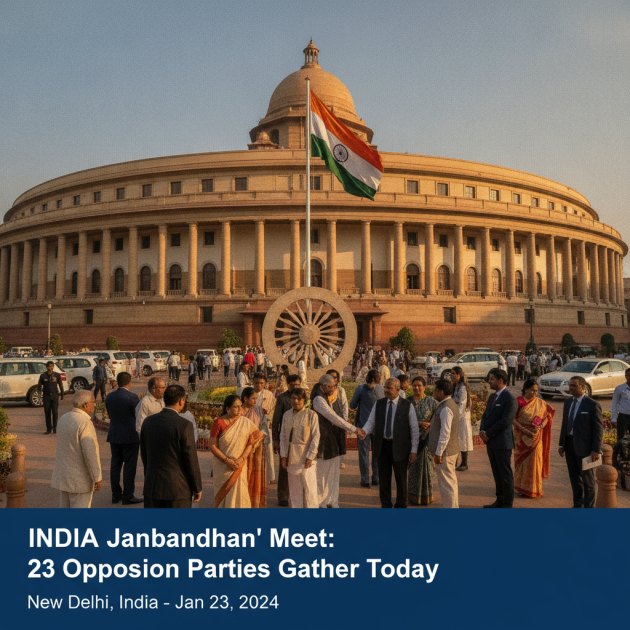
INDIA Janbandhan Meet: 23 Parties Unite for 2026 Elections
INDIA Janbandhan Meet: 23 Opposition Parties Gather Today for a Crucial Political Strategy Session
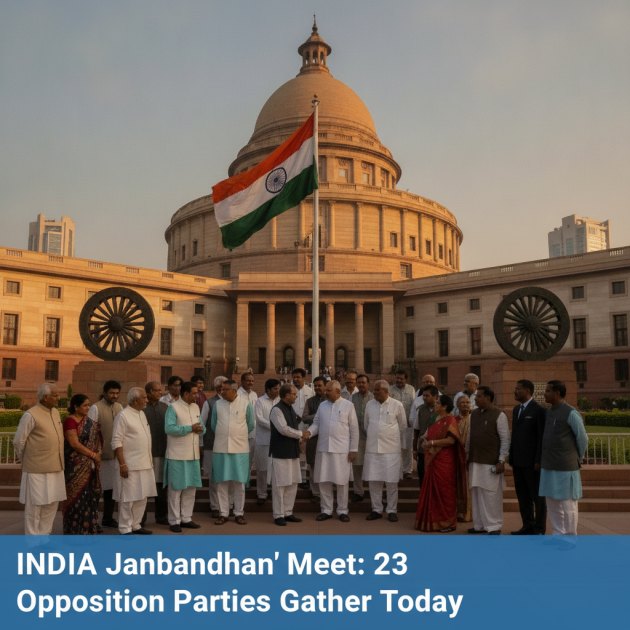
Did you know that in the fast-paced world of Indian politics, a single meeting can shift the entire electoral landscape? On this significant day, June 08, 2026, the nation's gaze is fixed on a pivotal gathering. Twenty-three opposition parties, a formidable bloc, are congregating for the much-anticipated INDIA Janbandhan meet. This isn't just another political huddle; it's a strategic summit aimed at forging a united front against the ruling establishment for the upcoming general elections. For you, the voter, understanding the dynamics at play here is crucial. What are their plans? Who are the key players? And most importantly, how will this INDIA Janbandhan meet impact your future? Let's dive deep into the heart of this political manoeuvre and unpack what it means for India.
The Grand Opposition Assembly: Who's Who at the INDIA Janbandhan Meet
The sheer number of parties—23, to be precise—attending the INDIA Janbandhan meet signifies a powerful intent. This isn't a minor alliance; it's a broad coalition representing a significant chunk of the Indian electorate. You'll find stalwarts from across the political spectrum, each bringing their own regional strength and national vision to the table. Think of leaders who have helmed states, commanded national attention, and have a deep understanding of the issues that affect your daily life, from the price of dal to the quality of your children's education.
Key Attendees and Their Influence
While the full list is extensive, some names stand out. Leaders from parties like the Indian National Congress, the Dravida Munnetra Kazhagam (DMK), the Trinamool Congress, the Aam Aadmi Party (AAP), the Nationalist Congress Party (NCP), and the Samajwadi Party are expected to be at the forefront. Each of these parties commands considerable influence in their respective strongholds. For instance, the Congress, despite recent electoral challenges, remains a pan-India force. The DMK is a dominant player in Tamil Nadu, the Trinamool in West Bengal, and AAP has made significant inroads in Delhi and Punjab. The Samajwadi Party holds sway in Uttar Pradesh, India's most populous state.
What's fascinating is how these diverse ideologies and regional ambitions are being brought together under the INDIA Janbandhan umbrella. It's a delicate balancing act, requiring compromise and a shared vision. The agenda likely revolves around identifying common ground, chalking out a joint strategy for campaigning, and potentially deciding on seat-sharing arrangements. This is where the real test lies – can they translate this unity in the meeting room into a cohesive electoral force on the ground?
Practical Takeaway: Keep an eye on the statements made by the senior leaders from these key parties. Their words will offer clues about the alliance's cohesiveness and their core messaging for the upcoming elections.
Decoding the INDIA Janbandhan Strategy: A United Front for 2026
The primary objective of the INDIA Janbandhan meet is clear: to present a united and formidable opposition to the ruling coalition in the 2026 general elections. This strategy hinges on the belief that a fractured opposition is no match for a well-entrenched incumbent. By coming together, they aim to consolidate anti-establishment votes, making it harder for the ruling party to win seats across the country. It's a classic political playbook: strength in numbers.
The Core Pillars of Their Strategy
Several key pillars are likely to form the bedrock of the INDIA Janbandhan's strategy:
- Issue-Based Alliances: Focusing on common grievances and national issues like unemployment, inflation, farmers' distress, and concerns over democratic institutions. This allows parties to find a shared narrative that resonates with a wider audience.
- Regional Strength Amplification: Leveraging the existing strongholds of each constituent party. Instead of fighting each other in every state, they aim to maximize gains by ceding space where another ally is stronger, thus preventing vote fragmentation.
- Joint Campaigning and Messaging: Presenting a unified face to the electorate. This could involve joint rallies, coordinated social media campaigns, and a common manifesto that reflects the aspirations of a broad spectrum of society.
- Leadership Consensus: While a single face for the Prime Ministership might be a point of contention, the strategy is to project collective leadership and a shared commitment to governance.
Consider the Lok Sabha elections of 2019 as a reference. A fragmented opposition struggled to make a significant dent. The INDIA Janbandhan meet aims to learn from those lessons and present a more cohesive alternative. For you, this means a clearer choice between two distinct visions for India's future.
Practical Takeaway: Watch for how the INDIA Janbandhan parties articulate their core issues. Do they sound united? Is their message consistent across different leaders? This will tell you how effective their strategy is likely to be.
Why This INDIA Janbandhan Meet Matters to YOU: The Voter's Perspective
You might be wondering, "How does this political chess game affect my life?" The answer is: profoundly. The outcome of the 2026 elections, shaped significantly by the INDIA Janbandhan's success or failure, will determine the policies that govern your economy, your social welfare, and your fundamental rights for the next five years. This meet is a crucial step in determining that outcome.
Impact on Key Issues Affecting Your Life
Let's break down how the INDIA Janbandhan's unified approach could influence critical areas:
- Economy and Jobs: A united opposition is more likely to push for policies addressing your concerns about job creation, controlling inflation, and supporting small businesses. Their collective voice can exert greater pressure on the government to implement effective economic reforms.
- Social Justice and Welfare: Issues like reservations, affirmative action, and social security schemes are often at the forefront of opposition agendas. A strong INDIA Janbandhan could champion these causes more effectively, potentially leading to improved welfare programs.
- Governance and Accountability: Opposition parties often focus on transparency, reducing corruption, and strengthening democratic institutions. A united front can hold the government more accountable for its actions and policies.
- Foreign Policy and National Security: While broad agreement often exists on national security, differing approaches to foreign policy can emerge. A unified opposition might present a more consistent stance on international relations, though this can also be a point of divergence.
Think about your own daily struggles. Are you worried about rising fuel prices? Is finding a stable job a constant challenge? Does the education system meet your expectations? The INDIA Janbandhan meet is an attempt by these parties to offer solutions and an alternative vision to address these very concerns. Their ability to present a credible alternative directly impacts your choices at the ballot box.
Practical Takeaway: Evaluate the INDIA Janbandhan's proposed solutions to the problems you face. Do their promises align with your needs and aspirations? Your vote is your power to choose the direction of the country.
Challenges and Opportunities for the INDIA Janbandhan Alliance
Forging and sustaining an alliance of 23 diverse parties is no small feat. The INDIA Janbandhan meet, while a symbol of unity, also highlights the inherent challenges this coalition faces. These are not minor hurdles; they are significant obstacles that could make or break their electoral prospects.
Navigating the Hurdles
Here are some of the major challenges:
- Leadership Vacuum/Rivalries: With multiple prominent leaders, the question of who will lead the charge, especially for the Prime Minister's post, remains a significant challenge. Internal rivalries and egos can easily derail consensus.
- Ideological Differences: While they may unite against a common foe, the constituent parties often have differing ideological standpoints on various issues, from economic policy to social matters. Reconciling these differences for a common platform is complex.
- Seat-Sharing Negotiations: This is often the most contentious part of any alliance. Deciding which party contests from which seat, especially in states where multiple allies have a presence, can lead to bitter disputes and potential defections.
- Maintaining Public Perception: An alliance perceived as opportunistic or unstable will struggle to gain public trust. They need to project a consistent image of purpose and commitment.
Seizing the Opportunities
Despite these challenges, the INDIA Janbandhan also has significant opportunities:
- Consolidated Vote Bank: If they manage to present a united front, they can consolidate a substantial portion of the anti-incumbency vote, which is often a deciding factor in Indian elections.
- Wider Appeal: By bringing together parties with strong regional bases and national ambitions, they can craft a narrative that appeals to a diverse electorate across different states and demographics.
- Focus on Core Issues: The need to unite forces them to focus on issues that resonate most with the common person, potentially leading to a more people-centric election campaign.
- Leveraging Social Media: A coordinated digital strategy can amplify their message, counter misinformation, and engage younger voters more effectively.
Consider the example of the Mahagathbandhan in Bihar in 2015. Despite differing ideologies, parties came together and achieved a significant victory by capitalizing on a shared objective. The INDIA Janbandhan hopes to replicate such successes on a national scale.
Practical Takeaway: Observe how the INDIA Janbandhan alliance handles internal disagreements. Their ability to resolve conflicts constructively will be a key indicator of their long-term viability.
Historical Context: Alliances in Indian Politics
The INDIA Janbandhan meet is not an isolated event. Alliances and coalitions have been a defining feature of Indian politics for decades. Understanding this historical context helps us appreciate the significance and complexities of the current political landscape.
From Single-Party Dominance to Coalition Era
For the first few decades after independence, the Indian National Congress enjoyed a near-monopoly on power. However, the late 1960s and 1970s saw the rise of regional parties and a more fragmented mandate. The 1990s marked the true beginning of the coalition era, with the formation of governments led by parties like the Janata Dal and later the Bharatiya Janata Party (BJP) and the Congress, often relying on support from a multitude of smaller parties.
The United Front governments of the 1990s, the National Democratic Alliance (NDA) led by the BJP, and the United Progressive Alliance (UPA) led by the Congress are prime examples of how diverse political entities have come together to form governments. Each of these alliances had its own set of challenges and successes, offering valuable lessons for contemporary political formations like the INDIA Janbandhan.
Lessons from Past Coalitions
What can we learn from these historical alliances?
- The Importance of a Common Minimum Program: Successful coalitions often operate on a Common Minimum Program (CMP) that outlines shared objectives and policy priorities, minimizing friction.
- Leadership and Stability: A strong, acceptable leadership is crucial for holding a coalition together. Instability often arises from leadership disputes or the defection of key allies.
- Regional Dynamics: The influence of regional parties is paramount. Their support can make or break a national government, and their demands often shape policy.
- Electoral Performance: While alliances can consolidate votes, their ultimate success depends on their ability to connect with the electorate and convince them of their vision for the country.
The INDIA Janbandhan meet is, in many ways, a continuation of this long tradition of political bargaining and strategic convergence. The success of this particular alliance will be judged not just by its ability to unite today, but by its capacity to translate that unity into electoral victories and stable governance tomorrow.
Practical Takeaway: Remember that alliances are dynamic. Keep track of how the INDIA Janbandhan evolves, drawing parallels with past successful and unsuccessful coalitions to better understand its potential trajectory.
Frequently Asked Questions (FAQ) about the INDIA Janbandhan Meet
You've got questions, and we've got answers. Here's a look at some common queries about the INDIA Janbandhan meet:
Q1: What is the main goal of the INDIA Janbandhan meet?
Answer: The primary objective is to consolidate opposition forces and present a united front against the ruling government in the upcoming 2026 general elections. It aims to strategize on seat-sharing, joint campaigning, and formulating a common agenda to challenge the incumbent.
Q2: Why are so many parties involved? Is it a sign of strength or weakness?
Answer: The involvement of 23 parties is a clear attempt to maximize the opposition's collective strength. It signifies a recognition that a divided opposition is unlikely to succeed. While unity is its strength, managing such a large and diverse group also presents significant challenges in terms of coordination and decision-making.
Q3: Will this alliance definitely win the 2026 elections?
Answer: No political outcome is guaranteed. While the INDIA Janbandhan meet is a crucial step towards forming a strong opposition bloc, its electoral success will depend on numerous factors, including the effectiveness of their campaign, public sentiment, the ruling party's performance, and their ability to overcome internal differences.
Q4: How will this INDIA Janbandhan meet affect the common citizen?
Answer: The outcome of the 2026 elections, significantly influenced by the INDIA Janbandhan's performance, will determine the government's policies on economy, employment, social welfare, and national development for the next five years. A strong opposition can also lead to greater accountability from the ruling party.
Q5: What are the biggest challenges facing the INDIA Janbandhan alliance?
Answer: The biggest challenges include resolving leadership disputes, reconciling ideological differences among member parties, managing complex seat-sharing negotiations, and maintaining a cohesive public image that inspires trust and confidence among voters.
The Road Ahead: What to Expect After the INDIA Janbandhan Meet
The INDIA Janbandhan meet on June 08, 2026, is more than just a day of deliberations; it's the beginning of a critical phase in India's political journey. What happens next will be closely watched by millions. You can expect the alliance to move towards finalizing seat-sharing agreements in key states, which will be a true test of their unity. Joint rallies and coordinated campaigns will likely follow, aimed at projecting a united front and amplifying their message.
However, the path is fraught with potential pitfalls. Internal disagreements, leadership tussles, and the inherent complexities of managing such a large coalition could surface. The media, and indeed all of us as citizens, will be scrutinizing every move. Will they be able to sustain this unity until the elections? Can they present a compelling vision that captures the imagination of the Indian voter?
Your role as a voter is paramount. Engage with the political discourse, critically analyze the promises made by all parties, and make an informed decision when the time comes. The INDIA Janbandhan meet is a significant development, but it is your informed choice that will ultimately shape the future of India. Stay informed, stay engaged, and make your voice heard.