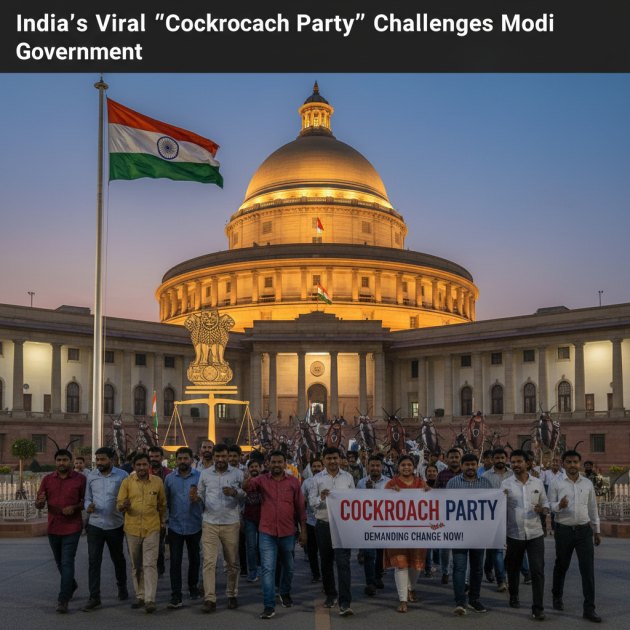
India's Viral 'Cockroach Party': A New Political Challenge for Modi?
Did you know that a single, seemingly insignificant pest could become a symbol of widespread discontent? In India, it's happening. A viral phenomenon, dubbed the 'Cockroach Party,' has unexpectedly emerged as a peculiar yet potent political challenge to Prime Minister Narendra Modi's government. This isn't about a formal political outfit with manifestos and rallies; it's a grassroots, social media-fueled movement that reflects a deeper undercurrent of public frustration. As we navigate the complex landscape of India politics 2026, understanding this 'Cockroach Party' is crucial for anyone wanting to grasp the evolving dynamics of governance and public sentiment.
The Rise of the 'Cockroach Party': More Than Just a Meme
It started innocently enough. A series of viral social media posts, memes, and short videos depicting cockroaches in various unflattering, yet strangely relatable, scenarios began to gain traction. Initially dismissed as just another internet fad, the 'Cockroach Party' quickly evolved. People started using the term to describe situations where a problem, often ignored or downplayed by authorities, stubbornly persists and multiplies, much like cockroaches in a neglected household. The phrase 'joining the Cockroach Party' became a sarcastic way to express solidarity with those facing bureaucratic hurdles, inflation, or unaddressed civic issues.
From Memes to Manifestos (Sort Of)
What most people miss is the underlying message. The 'Cockroach Party' isn't a joke for its participants; it's a symbol of resilience in the face of adversity. When a government initiative fails to deliver, when essential services are lacking, or when economic pressures mount, citizens find themselves metaphorically 'part of the Cockroach Party' – surviving, adapting, and often feeling unheard. The sheer ubiquity of the symbol, its ability to transcend regional and linguistic barriers, has made it a powerful, albeit unconventional, tool for expressing dissent. It taps into a shared Indian experience of navigating complex systems and often dealing with seemingly insurmountable problems.
Consider the common scenario of a resident in a major Indian city struggling with erratic water supply. Despite repeated complaints to the municipal corporation, the problem persists. They might sarcastically remark, 'Looks like we're all invited to the Cockroach Party tonight!' This isn't just about water; it’s about a feeling of powerlessness and the government's perceived inability or unwillingness to address basic needs. The 'Cockroach Party' gives a voice to this collective frustration.
Practical Takeaway: The 'Cockroach Party' phenomenon highlights how even informal, digital movements can reflect genuine public grievances. As a citizen, recognizing these informal channels of expression can help you understand the pulse of the nation beyond official statements.
Why is the 'Cockroach Party' a Challenge to Narendra Modi?
Prime Minister Narendra Modi and the Bharatiya Janata Party (BJP) have built a formidable political brand around efficiency, decisive governance, and problem-solving. Their narrative often emphasizes progress, development, and the eradication of long-standing issues. The 'Cockroach Party,' by its very nature, directly challenges this narrative. It suggests that despite the government's best efforts, or perhaps due to systemic flaws, many problems are not being solved but are instead festering and growing.
The Symbolism of Persistence
The cockroach is a symbol of persistence, survival, and the ability to thrive in difficult conditions. In the context of India politics 2026, this translates to citizens finding ways to cope with issues like rising inflation, unemployment, and bureaucratic red tape. When the government aims for a narrative of 'Acche Din' (Good Days) or a 'Viksit Bharat' (Developed India), the pervasive presence of 'Cockroach Party' sentiments suggests a significant disconnect between the official vision and the ground reality for many.
For instance, a recent viral video showed a group of young graduates protesting unemployment, holding signs that read, 'Welcome to the Cockroach Party: We've Been Expecting You.' This wasn't just a protest; it was a powerful indictment of the job market and the government's employment schemes. It directly contrasts with the government's claims of job creation and economic growth.
Real-World Example: In early 2026, a series of reports highlighted how small businesses were struggling to navigate GST (Goods and Services Tax) compliance, leading to delays and financial strain. Online discussions frequently used the 'Cockroach Party' metaphor to describe their plight, implying that the system itself was designed to be difficult, and only the most persistent (or cockroach-like) could survive.
The Opposition's Unlikely Ally?
While the 'Cockroach Party' is largely a spontaneous, leaderless movement, opposition parties are beginning to notice its potential. They haven't officially adopted the term, but they are increasingly using similar language and referencing the underlying sentiments in their political discourse. They highlight issues that resonate with the 'Cockroach Party' narrative – inflation, unemployment, and governance gaps – to question the effectiveness of the Modi government's policies.
What most people miss is that the opposition might not be able to create such a viral movement organically. The 'Cockroach Party' is powerful precisely because it appears to be a genuine, citizen-led expression of frustration, not a manufactured political attack. If the opposition tries too hard to co-opt it, they risk diluting its authenticity.
Practical Takeaway: For voters, the 'Cockroach Party' serves as a reminder to look beyond official pronouncements and consider the lived experiences of fellow citizens when evaluating a government's performance.
The Economic Underpinnings of the 'Cockroach Party' Sentiment
At its core, much of the 'Cockroach Party' sentiment is driven by economic anxieties. While India's economy has seen significant growth in recent years, the benefits have not always been evenly distributed. For a large segment of the population, the reality is a struggle to make ends meet.
Inflation Woes and Cost of Living
Rising prices for essential goods – from dal and vegetables to fuel and housing – are a major concern. When the average Indian's purchasing power erodes, and their hard-earned ₹ buys less, frustration naturally builds. The 'Cockroach Party' becomes a way to express this feeling of being squeezed by economic forces beyond their control, often exacerbated by perceived government inaction or inadequate relief measures.
Real-World Example: In the first quarter of 2026, vegetable prices in many Indian cities surged by over 30-40% due to unseasonal rains and supply chain disruptions. Social media feeds were flooded with memes and posts about the 'Cockroach Party,' lamenting the inability to afford basic nutrition and questioning why the government's price stabilization measures seemed ineffective.
Unemployment and Underemployment
The promise of jobs, particularly for the youth, remains a critical issue. Despite government efforts and the growth of certain sectors, the number of job seekers often outpaces the availability of well-paying, stable employment. The 'Cockroach Party' sentiment resonates with graduates facing a tough job market, skilled workers struggling to find roles commensurate with their qualifications, and those in the informal sector facing precarious livelihoods.
Scenario: Imagine a young engineer, armed with a degree from a reputed institution, working a low-paying gig economy job because they can't find a suitable engineering role. They might feel like they're part of the 'Cockroach Party' – surviving, but not thriving, despite their qualifications and the nation's economic ambitions.
Practical Takeaway: If you're feeling the economic pinch, know that you're not alone. The 'Cockroach Party' sentiment is a widespread reflection of these economic challenges. It's worth exploring resources for financial planning and skill development to better navigate these times.
Governance and Bureaucracy: The Breeding Ground
Beyond economics, the 'Cockroach Party' also finds fertile ground in the everyday experiences of navigating India's complex governance and bureaucratic systems. The perception that systems are often slow, inefficient, and sometimes corrupt fuels the sentiment.
Red Tape and Delays
Applying for permits, getting approvals, accessing government services – these processes can often be lengthy and frustrating. The 'Cockroach Party' metaphor captures the feeling of being stuck in a cycle of paperwork, follow-ups, and endless waiting, with little assurance of a timely or favorable outcome. It speaks to the sheer tenacity required to get things done.
Real-World Example: A small business owner trying to obtain an environmental clearance for expansion might spend months dealing with multiple government departments, submitting identical forms repeatedly, and facing unexpected delays. They might joke with peers, 'Just another day in the Cockroach Party!'
Civic Amenities and Neglect
Issues like poor road conditions, inadequate public transport, inconsistent power supply, and sanitation problems in many urban and rural areas also contribute to the 'Cockroach Party' sentiment. When basic civic amenities are not reliably provided, citizens feel neglected and that their fundamental needs are being overlooked. The persistence of these issues, despite being recurring problems, mirrors the resilience of the cockroach.
Comparison: Government Promises vs. Ground Reality
| Government Promises (Official Narrative) | Citizen Experience (The 'Cockroach Party' Reality) |
|---|---|
| Efficient governance and ease of doing business. | Navigating complex, slow bureaucratic processes. |
| Job creation and economic prosperity for all. | Struggling with unemployment, underemployment, and rising costs. |
| Improved urban infrastructure and civic services. | Dealing with persistent issues like poor roads, water, and sanitation. |
Practical Takeaway: If you're facing bureaucratic hurdles, remember to document everything, be persistent, and explore online grievance portals. Sometimes, a formal complaint can expedite a process.
The Future of the 'Cockroach Party' in Indian Politics
The 'Cockroach Party' is unlikely to disappear anytime soon. As long as there are governance gaps, economic disparities, and bureaucratic inefficiencies, the sentiment it represents will continue to resonate. Its evolution will be fascinating to watch.
Potential for Formalization?
While it's currently a decentralized, meme-driven phenomenon, could it morph into something more organized? It's possible, though unlikely in the traditional sense. A formal political party emerging from this would face immense challenges in structuring itself and presenting a cohesive agenda. However, the underlying issues it highlights are ripe for political mobilization by existing or emerging opposition forces.
A Barometer of Public Mood
More realistically, the 'Cockroach Party' will likely remain a powerful, albeit informal, barometer of public mood. It serves as an early warning system for the government, indicating areas of public dissatisfaction that might otherwise go unnoticed or be dismissed. For political analysts and the government alike, monitoring these digital conversations and understanding the sentiments behind them is crucial for gauging public opinion accurately.
Real-World Scenario: Imagine a scenario where local elections are approaching. If a particular issue, amplified by the 'Cockroach Party' narrative (e.g., persistent waterlogging in a constituency), becomes a major talking point online, it could influence voter sentiment and even campaign strategies.
The Modi Government's Response
How the Modi government responds to this informal challenge will be telling. Ignoring it risks alienating a significant portion of the populace. Acknowledging the underlying issues, even without directly referencing the 'Cockroach Party,' and demonstrating tangible improvements in areas of public concern could be a more effective strategy. This requires a listening approach and a willingness to address the 'sticky' problems that are often the hardest to solve.
Practical Takeaway: As citizens, engaging constructively in online discussions and advocating for solutions to persistent problems can contribute to positive change, even if it starts with a viral meme.
FAQ: Your Questions About the 'Cockroach Party' Answered
-
What exactly is the 'Cockroach Party'?
The 'Cockroach Party' is not a formal political organization. It's a viral, social media-driven phenomenon in India where the term is used metaphorically to describe persistent, often ignored problems and the resilience of citizens in dealing with them. It's a way to express frustration with issues like inflation, unemployment, and bureaucratic inefficiencies.
-
Is this a serious political threat to Prime Minister Narendra Modi?
While not a direct electoral threat in the traditional sense, the 'Cockroach Party' sentiment poses a significant challenge to the Modi government's narrative of efficient governance and progress. It reflects a disconnect between official claims and the everyday realities faced by many citizens, potentially impacting public perception and trust.
-
Who started the 'Cockroach Party' movement?
There is no single founder or leader. The 'Cockroach Party' emerged organically from social media, driven by countless individual users sharing memes, videos, and comments that resonated with a shared experience of persistent problems. Its strength lies in its decentralized, grassroots nature.
-
How does the 'Cockroach Party' relate to India politics 2026?
In the context of India politics 2026, the 'Cockroach Party' serves as an indicator of public sentiment. It highlights the issues that are likely to be prominent in political discourse – economic challenges, governance effectiveness, and citizen grievances. Political parties, including the opposition, may leverage these sentiments in their campaigns and messaging.
-
What can citizens do if they feel part of the 'Cockroach Party'?
If you feel frustrated by persistent issues, you can channel that energy constructively. Engage in informed discussions online, use official grievance redressal mechanisms, support community initiatives addressing local problems, and, most importantly, exercise your right to vote based on a comprehensive evaluation of performance and promises.
-
Is there any official government response to this 'Cockroach Party' sentiment?
As of now, there hasn't been a direct, official acknowledgement of the 'Cockroach Party' as a phenomenon by the central government. However, the underlying issues it represents – inflation, employment, governance – are constantly addressed in government policy discussions and public statements, albeit through different terminology.
Conclusion: Resilience and the Road Ahead
The 'Cockroach Party' is more than just a catchy, albeit unappealing, moniker. It's a potent symbol of the resilience and enduring spirit of the Indian people, who continue to navigate complex challenges with grit and adaptability. It serves as a stark reminder to policymakers that progress is measured not just by grand statistics, but by the everyday realities of citizens.
For the Modi government, this viral sentiment presents an opportunity – to listen more closely, address the persistent 'cockroach' issues that plague daily life, and reinforce the trust of the people. For citizens, it's a call to remain engaged, to voice concerns constructively, and to hold their leaders accountable. The enduring nature of the 'Cockroach Party' suggests that the challenges it represents are deeply ingrained, and tackling them will require sustained effort, innovative solutions, and a genuine commitment to improving the lives of all Indians.
Your Next Step: Stay informed about the issues that matter to you. Share your experiences and constructive feedback through appropriate channels. Your voice, amplified by collective sentiment, can contribute to shaping a better future for India.