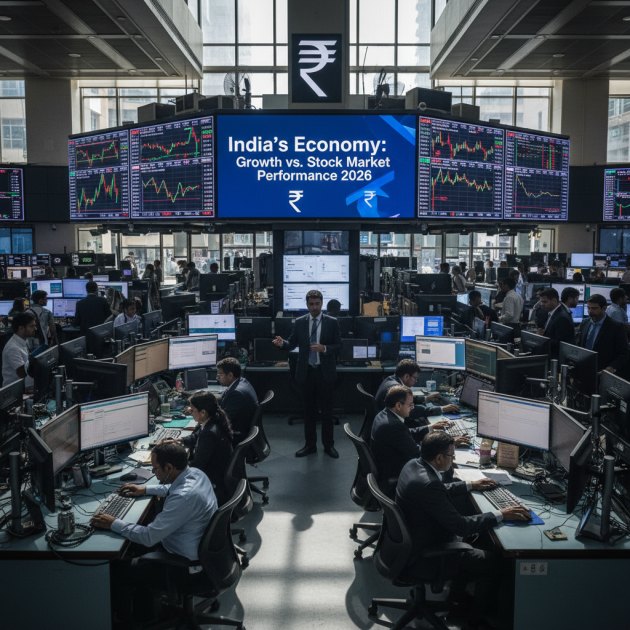
India Economy 2026 vs. Stock Market: Decoding the Disconnect
India Economy 2026 vs. Stock Market: Decoding the Disconnect
Imagine this: India's economy is booming, GDP is soaring, and businesses are expanding. Yet, the stock market, often seen as a barometer of economic health, seems to be lagging. Sounds like a paradox, right? In 2026, many Indians are looking at this very situation, wondering why their wallets might not feel as full as the headlines suggest. This disconnect between the India economy 2026 and its performance on the stock market India is a crucial topic for every investor and citizen. Why is this happening, and what does it mean for your financial future? Let's dive deep.
The Roaring Economy: What the Numbers Say
By 2026, India is projected to be one of the fastest-growing major economies globally. Reports from various international financial institutions consistently place India's GDP growth rate well above the global average. We're talking about a robust expansion driven by a burgeoning middle class, increasing consumption, significant government infrastructure spending, and a growing manufacturing sector spurred by initiatives like 'Make in India'.
Consumption Powerhouse
Your household spending is a huge driver. As disposable incomes rise for millions, the demand for goods and services – from smartphones and cars to housing and travel – escalates. This increased consumption fuels business revenues and, in theory, should translate to higher stock valuations.
Infrastructure Push
The government's relentless focus on infrastructure development – roads, railways, ports, and digital connectivity – creates jobs, stimulates economic activity, and improves the overall ease of doing business. Companies involved in construction, cement, steel, and logistics often see a direct benefit.
Manufacturing Momentum
Global supply chain realignments and government incentives are encouraging more manufacturing to set up shop in India. This not only creates employment but also boosts exports and strengthens the industrial base.
Practical Takeaway: Keep an eye on government policy announcements and major infrastructure project completions. These are strong indicators of where economic growth is being actively fostered.
The Sluggish Stock Market: Where's the Reflection?
Despite these strong economic fundamentals, the Indian stock market, represented by indices like the Nifty 50 and Sensex, might not be showing a commensurate surge. You might see headlines about record GDP but then look at your investment portfolio and feel underwhelmed. This is where the economic growth vs market performance debate heats up.
Global Headwinds
The global economic climate in 2026 plays a significant role. Rising interest rates in major economies like the US, geopolitical tensions, or a slowdown in other key markets can lead foreign institutional investors (FIIs) to pull money out of emerging markets like India. This outflow can depress stock prices, regardless of domestic economic strength.
Consider the scenario where FIIs, spooked by a potential recession in Europe or the US, decide to reduce their exposure to riskier assets. They might sell their holdings in Indian companies, leading to a decline in the stock market India, even as Indian companies continue to report healthy profits domestically.
Inflationary Pressures and Interest Rates
While the economy grows, persistent inflation can force the Reserve Bank of India (RBI) to maintain or even increase interest rates to cool down the economy. Higher interest rates make borrowing more expensive for companies, potentially impacting their future profitability. For investors, higher interest rates on fixed deposits and bonds can also make the stock market seem less attractive by comparison.
Sectoral Disconnects
Not all sectors of the economy grow at the same pace. While IT and manufacturing might be on a tear, sectors like banking or consumer staples might face different challenges. The stock market is an aggregate of these diverse performances. If the dominant sectors in the index are facing headwinds, the overall market might appear sluggish even if other parts of the India economy 2026 are thriving.
Valuation Concerns
Sometimes, the stock market runs ahead of itself. If the market has already priced in a lot of future growth, even strong economic data might not lead to further significant price increases. Investors might be hesitant to buy at what they perceive as high valuations, waiting for a correction or more concrete signs of sustained earnings growth.
Practical Takeaway: Understand that the stock market reflects future expectations as much as current reality. Global events and interest rate policies can significantly influence market sentiment, sometimes overriding domestic economic positives.
Why Your Investments Might Not Be Soaring: A Deeper Dive
You're likely asking, "If the economy is growing, why aren't my mutual funds or direct stocks performing better?" Let's unpack some specific reasons impacting your personal financial journey.
The IT Sector's Global Dependence
India's Information Technology (IT) sector is a major contributor to our GDP and exports. However, it is heavily dependent on clients in the US and Europe. If these economies slow down, Indian IT companies often face reduced spending on projects, leading to slower revenue growth and impacting their stock prices. This global dependency can create a disconnect with the domestic economic narrative.
The Banking Sector's Balancing Act
While economic growth often means more lending and potentially higher profits for banks, they also face risks. Increased lending means increased credit risk. Furthermore, regulatory changes or a rise in non-performing assets (NPAs) can put pressure on bank profitability, even in a growing economy.
The Consumer Discretionary Slowdown Paradox
While overall consumption is rising, specific segments within consumer discretionary spending (like luxury goods or high-end electronics) might face a slowdown if inflation erodes purchasing power or if consumers become more cautious about future economic uncertainty. This can impact the stock performance of companies in these specific sub-sectors.
The Impact of Corporate Earnings
Ultimately, stock prices are driven by corporate earnings. If companies are unable to translate economic growth into higher profits – perhaps due to rising input costs, increased competition, or inefficient operations – then their stock prices will struggle to move up. You need to look beyond just GDP numbers and examine the actual profit margins and growth in earnings per share (EPS) of the companies you're invested in.
Real-World Scenario: Consider a hypothetical scenario in 2026. India's GDP grows by 7%. However, major IT firms report only 3% revenue growth due to a slowdown in US tech spending. Simultaneously, a cement company, benefiting from government infrastructure projects, reports 15% profit growth. The overall market index might show moderate gains, but your IT stocks could be flat, while your cement stocks are soaring.
Practical Takeaway: Diversify your investments across different sectors. Don't put all your eggs in one basket, especially if that basket is heavily reliant on global economic conditions.
Navigating the Disconnect: Strategies for Your Portfolio
So, how do you, as an investor, navigate this complex landscape where the India economy 2026 and the stock market India seem to be on different paths? It's all about informed strategy and a long-term perspective.
Focus on Fundamentals
Always invest in companies with strong fundamentals: healthy balance sheets, consistent revenue growth, robust profit margins, and good management. Even in a sluggish market, fundamentally strong companies tend to outperform over the long run. Look at their debt-to-equity ratio, return on equity (ROE), and earnings per share (EPS) growth.
Diversification is Key
As mentioned, don't limit yourself to one sector or asset class. Spreading your investments across equities, debt instruments, and perhaps even real estate or gold can help cushion the impact of underperformance in any single area. Consider mutual funds that offer diversified portfolios.
Long-Term Investing Horizon
The stock market is notoriously volatile in the short term. If you have a long-term investment horizon (5-10 years or more), short-term market fluctuations become less critical. Focus on the overall growth trajectory of the Indian economy and the companies you invest in, rather than daily price movements.
Dollar-Cost Averaging (DCA)
Consider investing a fixed amount regularly, regardless of market conditions. This strategy, known as dollar-cost averaging, allows you to buy more units when prices are low and fewer units when prices are high, potentially lowering your average cost per unit over time. This is particularly effective in volatile markets.
Stay Informed, Not Emotional
Keep yourself updated on economic news, policy changes, and market trends. However, avoid making impulsive investment decisions based on fear or greed. Stick to your investment plan.
Comparison: Economic Growth vs. Market Performance Strategies
| Factor | Economic Growth Focus | Stock Market Performance Focus | Your Strategy |
|---|---|---|---|
| Driver | GDP, consumption, infra spending | Corporate earnings, investor sentiment, global flows | Balanced approach, long-term view |
| Time Horizon | Medium to Long Term | Short to Long Term (depending on strategy) | Long Term |
| Key Metrics | GDP growth rate, inflation, employment | P/E ratio, EPS growth, market cap, index performance | Company fundamentals, diversification, risk tolerance |
| Action | Invest in sectors benefiting from growth | Identify undervalued stocks, manage risk | Diversify, DCA, focus on quality |
Practical Takeaway: A disciplined approach combining fundamental analysis with a long-term, diversified strategy is your best bet to navigate market volatility and align your investments with India's economic potential.
The Role of Global Factors in 2026
It's impossible to discuss the stock market India without acknowledging the powerful influence of global events. In 2026, several international factors could be at play, impacting even a robust India economy 2026.
Geopolitical Stability
Conflicts or political instability in major global regions can trigger 'flight to safety' where investors move their money from riskier emerging markets to perceived safe havens like gold or government bonds in developed nations. This can lead to significant capital outflows from India.
Commodity Prices
India is a net importer of crucial commodities like crude oil and certain metals. Fluctuations in global commodity prices directly impact inflation, corporate costs, and the country's trade deficit. A sharp rise in oil prices, for instance, can dampen economic growth and hurt market sentiment.
Global Interest Rate Environment
As mentioned earlier, the monetary policies of central banks like the US Federal Reserve have a ripple effect. If they continue to keep interest rates high to combat inflation, it makes investing in US bonds more attractive than Indian equities for global investors, potentially leading to outflows.
Trade Policies and Tariffs
Changes in international trade agreements or the imposition of new tariffs by major trading partners can affect India's export-oriented industries and manufacturing sector, influencing corporate earnings and stock performance.
Real-World Example: Imagine a sudden escalation of conflict in Eastern Europe in early 2026. Global crude oil prices spike to $120 per barrel. This immediately increases India's import bill, puts pressure on the rupee, and fuels domestic inflation. The RBI might be forced to consider a rate hike, and foreign investors, worried about the global economic fallout, might sell off their Indian holdings, causing the Nifty to correct despite strong domestic economic data.
Practical Takeaway: Stay aware of major global economic and geopolitical developments. These can be early indicators of potential market movements.
Frequently Asked Questions (FAQ)
Q1: Is the Indian stock market always a perfect reflection of the economy?
Answer: No, not always. The stock market is forward-looking and influenced by many factors beyond just current economic growth. These include investor sentiment, global economic conditions, interest rates, corporate earnings expectations, and speculative trading. Sometimes, the market can be overly optimistic or pessimistic compared to the actual economic situation.
Q2: What does it mean if the economy is growing but the stock market isn't?
Answer: It suggests a potential disconnect. This could be due to global factors (like FII outflows), high inflation prompting tight monetary policy, concerns about future corporate earnings despite current growth, or the market having already priced in the expected growth. For you, it means being cautious and focusing on solid company fundamentals rather than just the headline GDP numbers.
Q3: Should I stop investing if the stock market is not performing well despite economic growth?
Answer: Not necessarily. If you have a long-term investment goal, market downturns can actually be opportunities to buy quality stocks at lower prices through strategies like SIP (Systematic Investment Plan) or dollar-cost averaging. However, it's wise to review your investment strategy and risk tolerance during such periods.
Q4: How can I identify companies that are likely to perform well even if the broader market is sluggish?
Answer: Focus on companies with strong competitive advantages (moats), consistent profit growth, low debt, good management, and products/services in high demand, ideally less dependent on global economic cycles. Look for companies that are leaders in their respective sectors and have pricing power to pass on costs.
Q5: What are the key indicators I should watch for to understand the true health of the India economy 2026?
Answer: Beyond GDP, watch for indicators like manufacturing and services PMI (Purchasing Managers' Index), inflation rates (CPI, WPI), unemployment figures, credit growth, corporate earnings growth, foreign exchange reserves, and trade balance. These provide a more granular view of the economy's health.
The Path Forward: Aligning Your Strategy with Reality
The year 2026 presents a fascinating case study in the relationship between the India economy 2026 and its stock market performance. While robust economic growth is a positive sign, it's crucial to understand that the stock market is a complex beast, influenced by a myriad of domestic and international factors. Your ability to navigate this landscape hinges on informed decision-making, a disciplined approach, and a long-term perspective.
Don't let the headlines about soaring GDP lull you into complacency, nor should a sluggish market cause panic. Instead, use this understanding to refine your investment strategy. Focus on the fundamentals of the companies you invest in, diversify your portfolio wisely, and maintain a patient outlook. By doing so, you can position yourself to benefit from India's long-term economic potential, regardless of short-term market fluctuations.
Call to Action: Review your investment portfolio today. Are your investments aligned with your long-term financial goals and risk tolerance? Consider consulting a SEBI-registered investment advisor to create or refine a strategy that works for you in the dynamic Indian financial market. Remember, knowledge and patience are your greatest allies.
Disclaimer: This article is for informational purposes only and does not constitute financial advice. Investing in the stock market involves risks. Please consult with a qualified financial advisor before making any investment decisions.